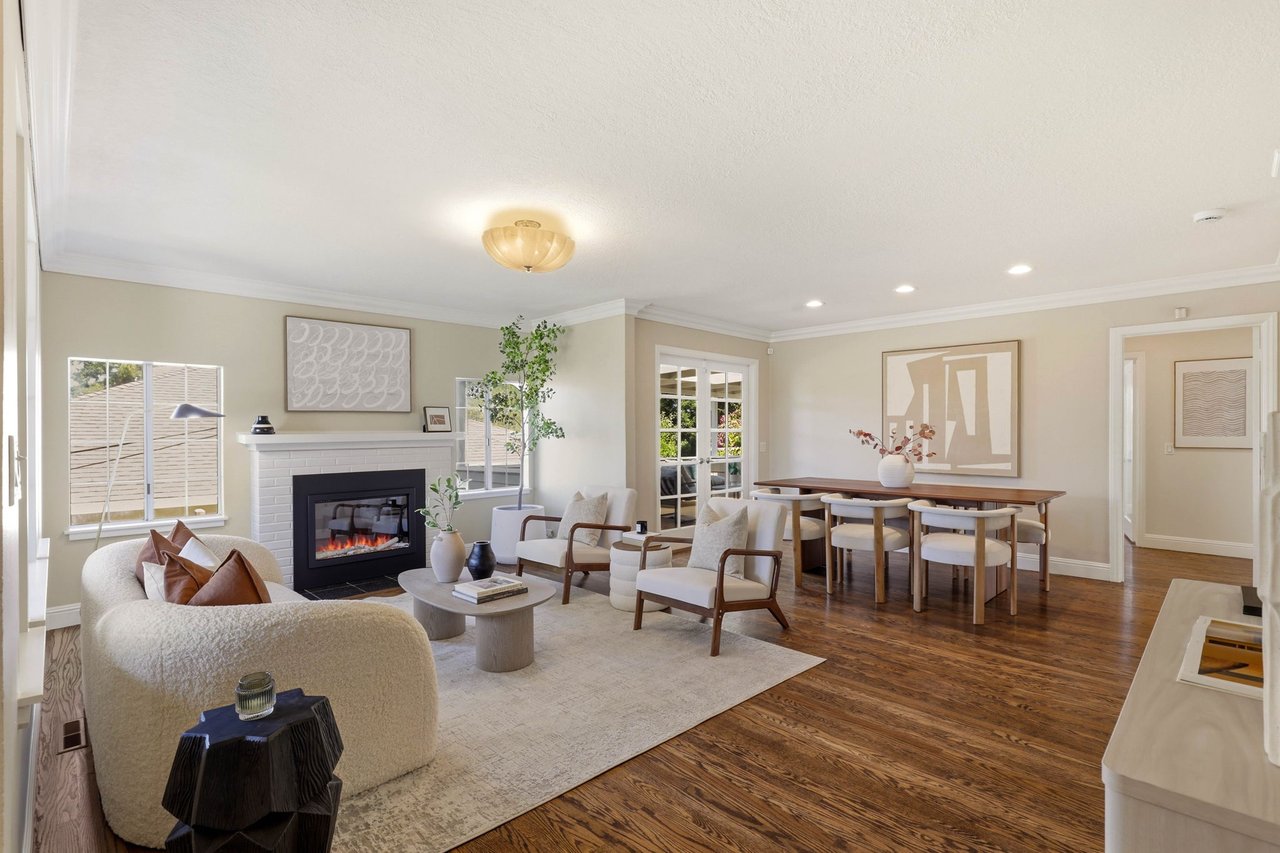
Does home staging actually increase what a Bay Area home sells for?
Yes, and meaningfully so. According to the National Association of Realtors' Profile of Home Staging, 81% of buyers' agents report that staging makes it easier for buyers to visualize a property as their future home, and sellers' agents consistently report that staged homes sell faster and for more money than unstaged counterparts. On the Peninsula, where buyers are sophisticated and inventory is tight, presentation isn't a nicety. It's a pricing strategy.
What Staging Actually Does for Your Sale Price
Here's what I tell every seller who asks me about staging: buyers don't make offers on houses. They make offers on how a house makes them feel. That emotional response happens in the first 90 seconds of a showing, and it either builds urgency or it doesn't.
In San Carlos right now, recent Zillow market data puts the median sale price at $2,580,000, with homes spending a median of 51 days on market. There are only 30 active listings available, with 17 new listings in the past 30 days and 89 homes sold in the trailing 90 days. That's a tight, competitive environment, but tight inventory doesn't automatically mean easy money. Buyers at this price point have seen a lot of homes. They know the difference between a home that's been prepared and one that hasn't.
According to NAR's staging data, 23% of sellers' agents report a 1–5% increase in the dollar value offered on staged homes compared to similar unstaged homes. At Peninsula price points, that's a significant number. More importantly, staged homes generate more competing offers, and competing offers are what push a final sale price above asking.
The Psychology Behind Buyer Behavior
When a buyer walks into a well-staged home, they're not thinking about what they'd change. They're imagining their life there. That's the goal. The NAR report also found that 58% of buyers' agents said staging had an effect on most buyers' view of the home. Remove the clutter, depersonalize the space, and let the architecture speak, and buyers start competing for the property instead of negotiating against it.
Thoughtful staging drives more top offers than almost anything else a seller can do to a home before listing. I've seen this play out across hundreds of transactions on the Peninsula over four decades. The homes that photograph beautifully, show cleanly, and feel move-in ready consistently outperform comparable listings that don't get that preparation.
A Room-by-Room Staging Priority Guide
Not every room carries equal weight with buyers. Here's how I advise sellers to prioritize their staging investment:
Highest-Impact Spaces
- Living room: The first room buyers evaluate. Furniture placement, natural light, and neutral tones set the tone for the entire showing.
- Primary bedroom: Buyers want to feel like they're entering a retreat. Clean lines, quality bedding, and minimal personal items matter here.
- Kitchen: Clear the counters entirely. A clean, uncluttered kitchen reads as larger and more functional, two things Peninsula buyers pay a premium for.
- Primary bathroom: Fresh towels, clean fixtures, and a spa-like feel convert quickly. Small investments (new hardware, fresh caulk, a quality mirror) return multiples.
Supporting Spaces
- Dining room: A properly scaled table with simple place settings helps buyers understand how they'd actually use the space.
- Home office: Especially relevant for Peninsula buyers in tech. A staged office that looks functional and intentional adds perceived value.
- Outdoor areas: In the Bay Area climate, usable outdoor space is a genuine amenity. Clean, furnished patios and decks photograph well and show even better.
According to the NAR staging profile, the living room (47%), primary bedroom (42%), and kitchen (35%) are the rooms buyers' agents most often recommend staging. That tracks with what I see on the Peninsula.
Staging vs. Interior Design: Understanding the Difference
Staging is not decorating. Interior design expresses the owner's taste. Staging removes the owner's taste from the equation entirely and replaces it with broad buyer appeal. The goal is to make the home feel like it belongs to no one, so the buyer can imagine it belonging to them. That means neutral palettes, appropriately scaled furniture, and deliberate editing of everything that personalizes the space.
The Fair Housing Act also means that staging choices should never be designed to appeal to or exclude any particular group, the goal is universal appeal, which is both legally sound and commercially smart.
The Pre-List Timeline: When Staging Happens
A question I get often is: how early do we start? My answer is always the same, earlier than you think.
Here's the general sequence that works for most Peninsula listings:
- 4–6 weeks before listing: Declutter, deep clean, and complete deferred maintenance. This is also when you identify what repairs will move the needle versus what's cosmetic noise.
- 2–3 weeks before listing: Professional stager walks the home, furniture is edited or brought in, paint touch-ups and minor cosmetic work are completed.
- 1 week before listing: Professional photography, video, and 3D tour capture. In the Bay Area, NAR research consistently shows that the overwhelming majority of buyers begin their search online, which means photography is your first showing.
- Listing goes live: The home is show-ready from day one. The first week of activity is the most important week of your listing.
The California Association of Realtors market data consistently reinforces what I see in practice: homes that enter the market in strong condition, priced correctly, generate the most activity in the first 7–10 days. That window matters more than any other period of the listing.
Every situation is different, and the only way to know exactly what your home needs is to walk through it with someone who knows what Peninsula buyers are responding to right now. That's where a pre-listing consultation pays for itself many times over.
Staging Focus Area | Buyer Impact (NAR) | Typical Prep Timeline |
|---|---|---|
Living Room | 47% of agents recommend staging first | 1–2 weeks before listing |
Primary Bedroom | 42% of agents recommend staging first | 1–2 weeks before listing |
Kitchen | 35% of agents recommend staging first | Declutter 4–6 weeks out |
Outdoor/Patio | High in Bay Area climate | 1 week before photography |
Home Office | Growing priority for Peninsula buyers | 1–2 weeks before listing |
Frequently Asked Questions
Does staging help homes sell faster in the San Francisco Bay Area?
Yes. According to NAR's staging research, staged homes spend less time on market than unstaged comparable homes. In a Peninsula market where the median days on market sits around 51 days, anything that accelerates buyer decision-making has real financial value, carrying costs, mortgage payments, and opportunity cost all add up during a listing period.
Is professional staging worth the cost in markets like San Carlos or Palo Alto?
At Peninsula price points, the return on a professional staging investment is almost always positive. NAR data shows 23% of sellers' agents report a 1–5% increase in offers on staged homes. When the median sale price in San Carlos is around $2,580,000, that math is compelling. Your specific return depends on the home's condition, price point, and how much staging it actually needs, which is exactly the conversation to have before you commit to any spend.
What rooms matter most when staging a Bay Area home?
The living room, primary bedroom, and kitchen consistently rank as the highest-impact spaces according to NAR's buyer and agent surveys. On the Peninsula specifically, a staged home office and usable outdoor space also carry significant weight given buyer demographics and the Bay Area's year-round outdoor lifestyle.
What is the difference between staging and interior design?
Staging removes the seller's personal taste and replaces it with broad, neutral appeal designed to help the widest range of buyers visualize themselves in the home. Interior design expresses the homeowner's style. For resale, staging wins every time, the goal is to create emotional connection for buyers, not to reflect the seller's preferences.
Do staged homes sell for more than unstaged homes in California?
The data points consistently in that direction. NAR's national research shows staged homes attract higher offers and more buyer interest. In California's competitive coastal markets, where buyers are making decisions at high price points and often competing against other offers, presentation quality directly influences both offer amounts and the number of offers received. Your specific outcome depends on your home, your neighborhood, and current market conditions.
The Bottom Line on Staging
Staging isn't about making a home look like a model. It's about removing every obstacle between a buyer and the decision to make a strong offer. On the Peninsula, where buyers are experienced, discerning, and often choosing between multiple properties, a well-prepared home doesn't just sell faster, it creates the competitive dynamic that produces the best possible price.
I've been guiding sellers through this process since 1984, and the homes that consistently outperform are the ones where the seller trusted the process, did the preparation, and entered the market ready to compete. If you're thinking about listing in San Carlos, Redwood City, Belmont, Menlo Park, or anywhere on the Peninsula, I'd welcome the chance to walk through your home and tell you exactly what I'd recommend before you go to market.
With 40+ years of experience, more than 3,100 homes sold, and a deep understanding of what Peninsula buyers respond to, I'm here to help you get the result your home deserves. Call me at 650-595-5500 for a confidential, no-pressure conversation, or reach out here.
Equal Housing Opportunity. Alex Lehr, CA DRE# 00867442, Guide Real Estate CA. This article is general information only and does not constitute legal, tax, or financial advice. Consult your attorney, tax advisor, lender, or escrow officer to confirm details specific to your transaction. California Department of Real Estate licensee. By contacting us, you consent to receive communications; message and data rates may apply.